


Your Coffee Machine Isn't Worth £7,000. It Could Be Worth Millions.
A coffee machine might just be one of the highest ROI investments in your building.
Most organisations are still measuring workplace investments the wrong way.
When budgets tighten, the conversation often starts with obvious questions:
"Do we really need the premium coffee machine?"
"Do we need breakout spaces?"
"Could we fit more desks in that area?"
On paper, these questions make sense.
A coffee machine costs money.
A collaboration space takes up valuable floor space.
Neither directly generates revenue.
But what if we're measuring the wrong thing?
The Hidden Value of Workplace Gravity

In every workplace there are invisible forces at work.
Certain spaces attract people.
They create movement, conversation and connection.
The coffee machine.
The kitchen.
The informal lounge.
The central staircase.
The breakout area.
These places create what we call workplace gravity.
People are drawn to them repeatedly throughout the day. As they gather, something far more valuable than coffee is produced.
Ideas.
Relationships.
Knowledge transfer.
Problem solving.
Innovation.
Culture.
A senior leader bumps into a graduate trainee and learns about a customer issue.
A project manager overhears a challenge and connects someone with the right expertise.
Two departments that rarely meet discover they are solving the same problem.
None of these interactions appear on a balance sheet.
Yet they are often where the most valuable work begins.
The Office Heat Map Nobody Sees
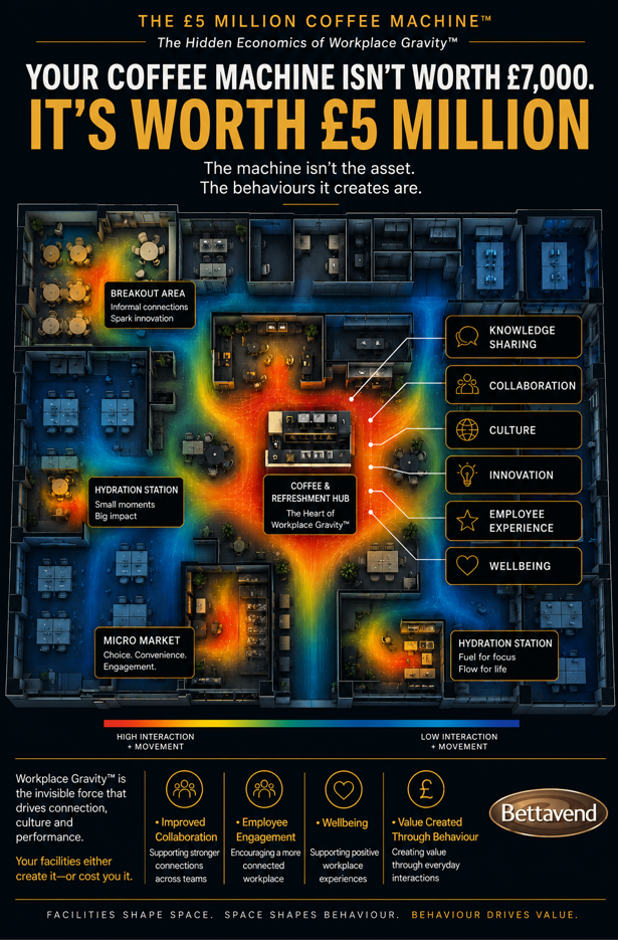
Imagine looking at your workplace through a heat map, like the above.
Not a heat map of occupancy.
A heat map of conversations.
The brightest areas wouldn't necessarily be meeting rooms.
They would be the places where people naturally collide.
Where conversations start without a calendar invitation.
Where information flows between teams.
Where trust is built.
Where innovation happens.
These interaction hotspots become disproportionately important because they connect people who would otherwise remain disconnected.
The physical environment shapes the social network of the organisation.
And the social network determines how knowledge moves.
Why This Matters More Than Ever

For years, workplace decisions focused on efficiency.
More desks.
Less space.
Higher utilisation.
But the most successful organisations are increasingly asking a different question:
"How do we create environments where people can do their best work together?"
The future of workplace experience isn't about squeezing more people into a building.
It's about increasing the quality and frequency of meaningful interactions.
Because innovation rarely happens in isolation.
It happens at the intersection of people, ideas and opportunity.
The £5 Million Coffee Machine

So is the coffee machine worth £7,000?
Of course.
But that's not the real question.
The real question is:
What is the value of thousands of conversations over five years?
What is the value of faster problem solving?
What is the value of stronger relationships?
What is the value of an idea that becomes a new product, a major client win or a breakthrough innovation?
Suddenly, the conversation changes.
The coffee machine isn't a workplace expense.
It's an investment in connection.
And connection is where organisational value is created.
The organisations that understand this will stop designing workplaces around space efficiency alone.
They'll design them around human interaction.
Because the most valuable assets in your workplace aren't always the ones you can easily measure.
Sometimes they're the ones bringing people together.
The Best Workplace Investment Isn't Always the Most Obvious.
Every organisation wants better collaboration, stronger culture and happier employees.
Sometimes, it starts with something as simple as creating a space people genuinely want to gather.
If you'd like to explore how your workplace could encourage more meaningful interaction, we'd love to help.